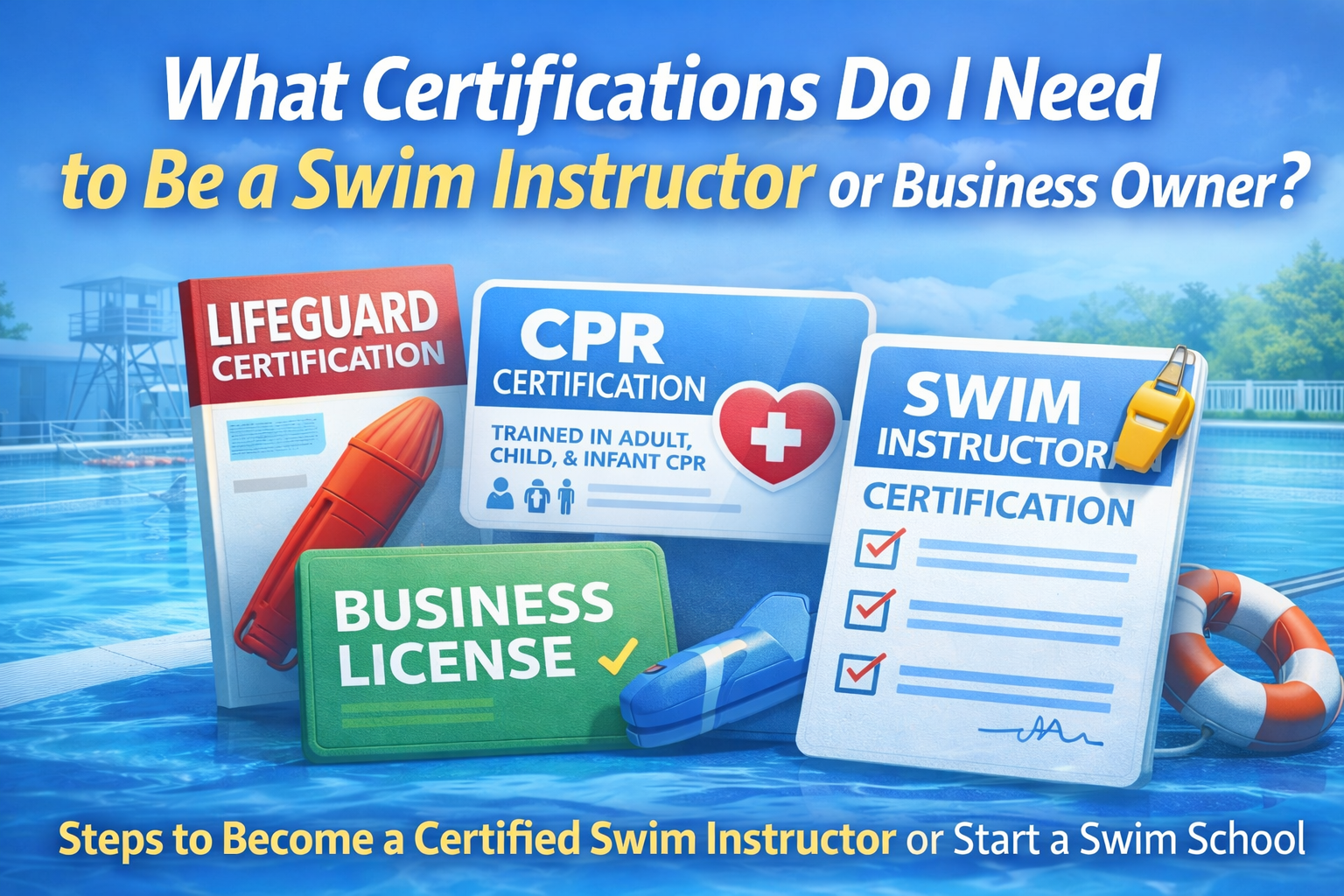
or Start a Swim School?
If you’re thinking about teaching swim lessons or starting your own swim school, you’re probably wondering:
What certifications do I actually need to be a swim instructor?
And…
Do I need special certifications to start a swim school?
The answer depends on where you teach, who you teach for, and whether you’re working independently.
Let’s break it down clearly.
Basic Certifications Most Swim Instructors Need
1. CPR and First Aid Certification (Required)
This is non-negotiable.
If you are teaching swim lessons, especially to children or babies, you should hold current:
- CPR certification (adult, child, and infant)
- First Aid certification
- AED training
Most facilities and insurance providers require this.
Even if you’re teaching private lessons at backyard pools, CPR certification is essential for safety and professionalism.
2. Lifeguard Certification (Sometimes Required)
A lifeguard certification is often required if you:
- Work for a public pool
- Teach at a recreation center
- Are employed by a swim facility
However, if you run your own private swim school, a lifeguard certification is not always mandatory, especially if you are the instructor in the water and actively supervising students.
Some instructors choose to maintain lifeguard certification for added credibility, but it’s not always legally required for private swim lesson businesses.
3. Swim Instructor Certification (Depends on Employer)
Large organizations often require instructor certification through nationally recognized programs.
Common certifying organizations include:
If you plan to work for one of these organizations, you’ll likely need their specific certification.
But here’s what surprises many people:
If you are starting your own private swim school, there is often no law requiring a specific brand certification.
What matters more is:
- Safety training
- Insurance coverage
- Business registration
- Demonstrated competency
Certifications Needed to Start a Swim School Business
If you’re becoming a swim school owner, you’re not just an instructor; you’re also a business owner.
Before launching your swim lesson business, make sure you understand the full startup investment. Read my complete breakdown of how much it costs to start a private swim school.
Here’s what you’ll typically need:
✅ CPR / First Aid Certification
✅ General Liability Insurance
Insurance is just one part of your startup budget. If you’re planning your next steps, here’s a full guide on starting a swim school from scratch.
✅ Business License (depending on your city/state)
✅ Waivers and safety policies
In some areas, health department permits may be required if you operate from your own facility.
Always check local regulations.
Do You Legally Need a Certification to Teach Private Swim Lessons?
In many states in the U.S., there is no universal federal law requiring a specific swim instructor certification to teach private lessons.
However:
- Insurance companies may require CPR certification.
- Pool rental facilities may require proof of certification.
- Parents will expect professionalism and safety standards.
Certification builds trust.
But certification alone does not guarantee you know how to teach effectively.
The Difference Between Certification and Competency
Here’s something important:
Certification proves you completed a course.
It does not automatically mean you know:
- How to structure progressive swim lessons
- How to teach babies vs. older children
- How to build confidence in fearful swimmers
- How to price and package lessons profitably
- How to scale your swim school
That’s where many instructors struggle.
They have the certificate… but not the system.
If You Want to Offer the Best Swim Lessons in Your Community
Getting certified is step one.
Learning how to teach exceptionally well is step two.
If your goal is to:
- Deliver high-quality, structured swim lessons
- Build confidence in babies and children
- Create a clear skill progression
- Start or grow a profitable swim school
Then you need more than a certification.
You need a proven teaching framework.
That’s exactly why I created the Online Swim Academy.
Why the Online Swim Academy Is Different
The Online Swim Academy is not a certification body.
You won’t receive an official instructor credential.
But you will learn:
- How to structure effective swim lessons
- How to teach babies, toddlers, and children safely
- How to build breath control and water confidence
- How to develop independent swimmers
- How to create systems that make your swim school sustainable
If you want to stand out in your community, not just meet minimum requirements, this is where you build real teaching confidence.
👉 Explore the Online Swim Academy here.
Whether you’re just starting or ready to grow your swim lesson business, it’s designed to give you clarity, structure, and direction.
Final Thoughts
To become a swim instructor, you typically need:
- CPR and First Aid certification
- Possibly a lifeguard certification
- Instructor certification (depending on employer)
To become a swim school owner, you’ll also need:
- Insurance
- Business setup
- Clear safety policies
But to become exceptional?
That requires intention, structure, and the right training beyond the basics.
Certification opens the door.
Skill and systems build the business.
If you’re serious about becoming a swim instructor and building your own business, your next step is understanding the financial side. Start here: How Much Does It Cost to Start a Private Swim School?
Leave a Reply